
Installation & Projects
Where Skirting Meets the Wall Panel: Solving the Junction Before Delivery
Two profiles meet at the base of every panelled wall. If their heights and projections are not checked together, the junction is where the fit-out looks unfinished.
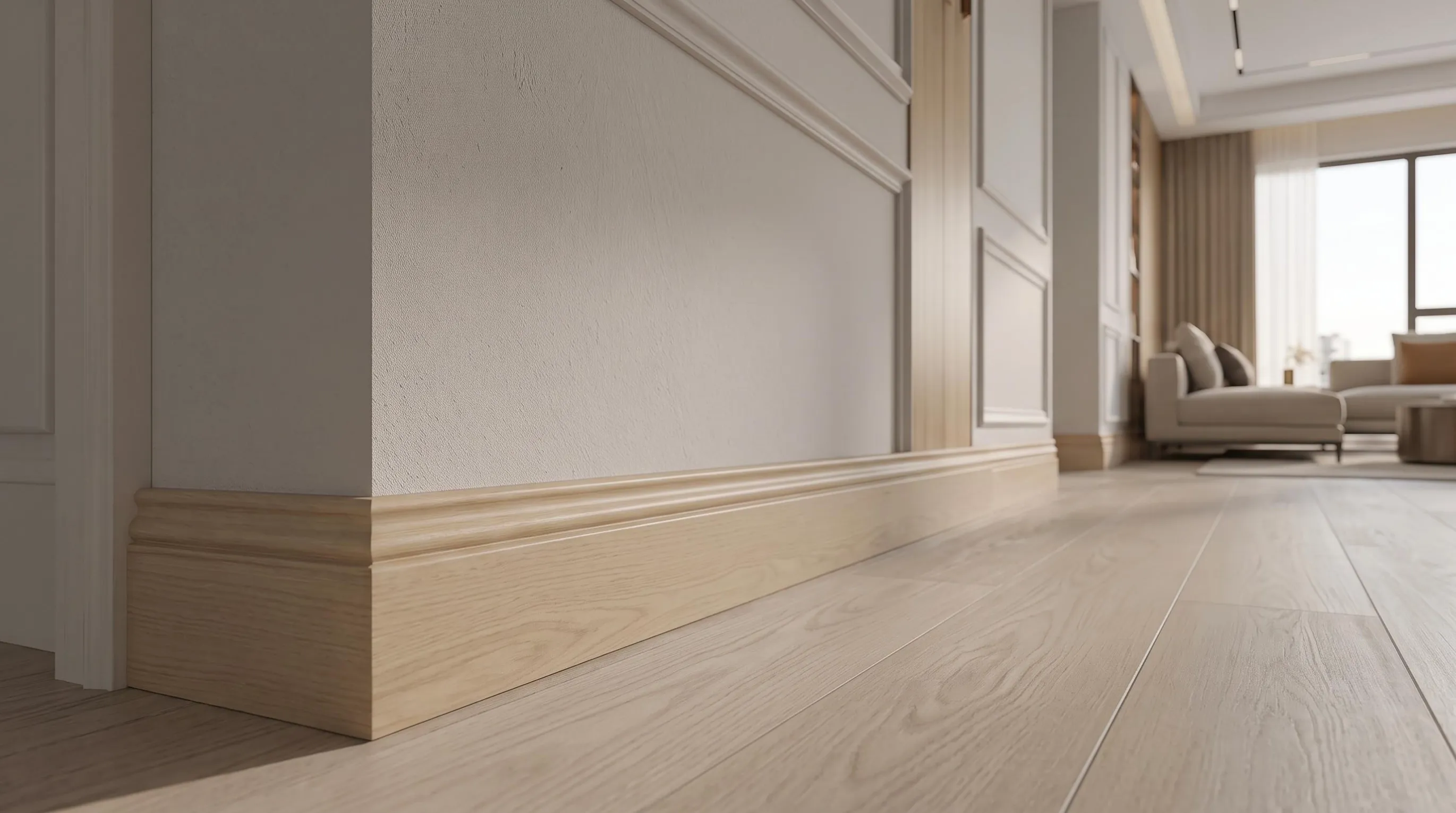
Every panelled wall has one line that decides whether the room reads as finished: the point where the wall treatment stops and the skirting begins. It is a single horizontal line running around the whole room, and it is usually the first detail anyone notices on entering.
Two profiles, two thicknesses, one plane
The skirting and the wall panel are separate profiles with separate depths, and both are fixed to the same wall. The PS skirting is approximately 12mm to 16mm thick. Wall panels in the same product family run from 4.5mm to 30mm, depending on the model.
Put those two numbers together and the junction problem appears immediately. A 4.5mm panel sits well behind the front surface of a 12mm skirting, so the skirting reads as a step. A 30mm panel projects further than any skirting in the range, so the skirting disappears behind the panel. Neither of those is wrong; both change what the junction looks like, and neither is obvious if the two items are specified in different conversations.
The check is arithmetic rather than aesthetic: compare the panel thickness with the skirting thickness before the order, and decide which of the two is meant to stand proud at that line.
The skirting and the panel never meet by accident. They meet because someone chose which one stands forward.
Height sets where the panel can end
The skirting is available in four heights, from 80mm up to 150mm, and that number is not only a proportion decision for the base of the wall. It is the datum the panel has to start from: whatever height you pick, the panel begins above it, and the panel height you need is the wall height minus the skirting height.
That subtraction is where a panel order goes wrong. A 150mm skirting under a 2.8m ceiling leaves 2.65m of wall above it. Against that figure, all three stock lengths sit on different sides of the line: 2.4m does not reach, while 2.9m and 2.8m both cover it and both end up trimmed, by 250mm and 150mm respectively. The skirting height is therefore part of what decides which length is worth ordering. Note that this 2.65m is measured from the top of the skirting to the ceiling; a panel run to the floor would be the full 2.8m, and the difference between the two figures is the skirting itself.
Two things follow from that. The panel length you order is driven by the datum rather than by the ceiling height alone. And the junction line itself becomes a measured figure on the drawing rather than something the installer arrives at by eye.
The top contour is what makes the line read
At this junction the top contour of the skirting does specific work: it puts a moulded shadow line exactly where the panel stops. That is what lets a panel run terminate cleanly at the skirting head instead of needing a separate bead or a scribed filler piece.
The consequence for specification is narrow but worth stating: the profile reference has to be fixed before the panel height is confirmed, because the height of the moulded head is part of the figure being subtracted from the wall height. A substitution later changes that figure.
Who resolves the tolerance at that line
At the base line, the two items meet with a known difference in projection, and the installation has to resolve the tolerance at that line. Whether the skirting sits proud of the panel or the other way round is a drawing decision, because it determines which edge has to be kept straight and which one is allowed to be covered.
That is why the two should be ordered against each other rather than separately. If the panel arrives and the skirting profile is still undecided, the junction gets resolved on site with whatever is to hand.
What to put in the enquiry
Give the wall height, the skirting height you want, and the panel model you intend to use above it. Those three together let the supplier confirm the panel length that actually fits the space above the skirting, and say which of the two profiles will stand further forward at the junction. If the answer to that last question is not what you intended, it is cheaper to find out before the boards ship.